
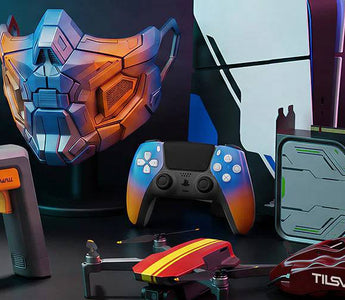
If you're a part of the realm of 3D printing, prop making, and miniature painting, you've already experienced the most dreadful problem: spending thirty hours perfecting an ultra-high-detail resin print or creating an exquisite piece of armor, only to see it fall apart in the coating stage.
The traditional painting techniques force artists to make several frustrating choices. Brushing with a brush can leave ugly, irregular brush strokes, which ruin smooth surfaces. Commercial spray bottles (rattle cans) provide no pressure control; they are quick to empty, get blocked easily, and transform into a nightmare of splattering as soon as the temperatures drop to temperatures below 15°C (59°F).
The most popular choice for detailing of the highest quality is the airbrush system. However, traditional airbrushes carry a huge baggage train. They're noisy, vibrating air compressors as well as stiff and knotted air hoses and a grueling learning curve that can turn beginner creators off.
The good news is that a change in paradigms is occurring in the workshops. A new category of micro cordless paint sprayers has emerged. It was designed specifically to bridge the giant gap between industrial paint guns as well as fragile, low-maintenance hobby airbrushes; these sprayers are quickly becoming the best upgrade for artists.

Why Traditional Paint Tools Fail the 3D Print & Miniature Test
The traditional tools destroy fine detail, and rattle cans aren't able to provide circulation control, and they splatter when in frigid weather. Industrial guns weigh too much at 1.5 kg and can blow lighter models to pieces, and traditional airbrushes attach the user to their desks with restricting hoses as well as loud 60 dB compressors.
For a better understanding of why a cordless sprayer has the potential to revolutionize our lives, it is necessary to consider where the traditional sprayers aren't able to meet the demands of complicated, massive projects.
Rattle can spray paints offer a hefty coating of paint. When applied to a highly detailed 3D print, or even a miniature model, this massive output immediately floods and ruins the delicate structural layers, panels, and lines as well as the fine facial characteristics.
In addition, you are unable to regulate either the speed of the airflow or the patterns of the fan. Industries with HVLP sprayers (paint guns intended for home improvement or fencing painting) are too large (often being between 1.5 and 1.8 kg once filled). In addition, their huge pressure can blow the lightweight 3D-printed model or tabletop miniaturization directly off your workstation.
Traditional airbrush systems: Although very precise, they connect the user permanently to one desk thanks to the wires for power and the air hoses. If you're looking to paint an enormous piece of cosplay or even prime your collection of tabletop-based terrains, an airbrush nozzle is just too small. It can turn a simple priming process into a lengthy process.
Key Features Every Maker Needs in a Cordless Paint Sprayer
Designers require a lightweight design (under 500 grams) to avoid wrist strain; a powerful brushless motor that stops the spitting of paint; and sub-1.0 mm micro-nozzles for extreme layers of precision and simpler fluid design that allows completing cleaning within just 60 minutes.
In evaluating an automated painting tool designed for work that is custom-made for hobbyists, traditional hardware store measurements are not applicable. Designers should be looking for the following four features:
1. Ultra-Lightweight Ergonomics
While you meticulously coat the model with a delicate material from many perspectives, the weight of the tool is crucial. The industrial tools can cause rapid stress on the wrist and fatigue in the hands and can result in shaking movements and even ruined surfaces. The made-to-order sprayer must feel comfortable and easy when held in your hand.
2. High-Speed Motor Stability
The cheaper cordless models typically suffer from drops in power because the battery gets depleted. The decline in pressure can cause the machine to "spit" or drop large and unatomized paint pieces on your job. An efficient brushless motor is necessary for maintaining a constant, fast flow of air from the beginning until the end.
3. Fine Atomization & Micro-Nozzles
To keep the microscopic detail of sculptures, or textured 3D prints The paint has to be separated into an ultra-fine mist. This is why precisely engineered micro-copper parts (typically sub-1.0 mm) disperse paint uniformly without any pooling.
4. Rapid, Hassle-Free Cleanup
There is nothing that kills creativity faster than cleaning and dismantling with a paint gun for the sake of switching hues. An efficient fluid path that is clean in just two minutes is a mandatory necessity.
Deep Dive: The Tilswall Hornet Maker Sprayer
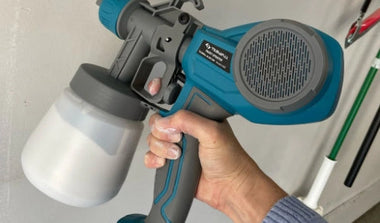
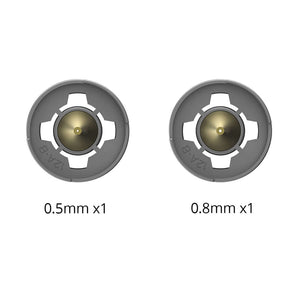
The Tilswall Hornet is an encapsulated sprayer weighing 450g that has the 100,000 RPM brushless motor as well as two 2000mAh batteries. It is a combination of 0.5 mm and 0.8 mm copper nozzles and paint that peels to provide quick, accurate coats of paint on complicated 3D geometrical shapes.
If you evaluate the market conditions against these rigorous producer specifications and standards, the Tilswall Hornet Cordless Paint Sprayer makes a statement as a custom-designed product rather than a rebranded industrial device.
With a weight of just 500 grams to 450 grams, the Hornet is 3 times smaller than traditional handheld sprayers. It's not as heavy a power tool, and instead, it's a comfortable, large marker that allows for easy wrist motion when painting complicated multi-angled geometries.
Under its light shell, it is equipped with an extremely high-speed brushless motor with a 100,000 RPM rating. This design option delivers an increase of up to four times spraying capabilities compared to traditional options from hardware stores while making sure the mist atomized remains homogeneous. With its specially designed 0.5 mm or 0.8 mm copper sprayers, it gives you the wide-stroke performance of a sprayer as well as the precision and tightness of an airbrush with a broad bore.
Additionally, it provides a wonderful safety feature for designers: complete support for peelable formulations of paint. If you make a mistake with the color scheme you want to use or commit mistakes in the masking process for a prototype that isn't very common, it is possible to remove the layer cleanly. Without the need for harsh chemical strippers or rough sanding, which could easily ruin the original 3D printing details.

Spec Comparison Table
| Specification | Traditional Hobby Airbrush Setup | Standard Industrial Paint Gun | Tilswall Hornet Cordless Sprayer |
| Total Weight | Varies (Heavy 3kg+ Compressor) | 1.5 kg – 1.8 kg | 450 grams (3x Lighter) |
| Motor Speed | N/A (External Compressor) | 15,000 – 30,000 RPM | 100,000 RPM Brushless |
| Portability | Tethered (Air hoses & cords) | Corded or Bulky Battery | 100% Cordless (Dual 2000mAh) |
| Nozzle Sizes | 0.2mm – 0.3mm (Too Small) | 1.5mm – 2.5mm (Too Large) | 0.5mm & 0.8mm Copper Nozzles |
| Cleanup Time | 15 – 20 Minutes | 15 Minutes | 60 Seconds |
| Paint Setup | Tedious thinning & mixing ratios | Requires thinning filters | Plug-and-Play (Zero Thinning) |
How to Paint 3D Prints and Miniatures Seamlessly
Get professional-looking finishes by preparing surfaces completely, then squeezing on a pre-thinned and rich-color Tilswall paint bottle that requires no mix-up by hand, keeping an airtight spraying range of 15-20 cm. Also, run a 60-second water flush right after completing the project.
The ability to achieve a factory-quality finish for your customized creations boils down to a neat and repeatable process.
Step 1: Post-Processing and Surface Prep
Prior to turning on the sprayer, be sure your resin, or FDM 3D print, is properly ready. Clean your resin prints well in isopropyl alcohol and then cure the prints. If you are using FDM prints (PLA/PETG), perform your required sanding process and then clean the surface with a tack cloth to eliminate tiny particles of plastic, which could cause damage to the bonding to the base coat.
Step 2: Setting Up the Paint (Zero Thinning Required)
If you use traditional airbrushes or paint guns, this is typically the most laborious step: calculating manually the ratio of paint to thinner, testing the cup viscosity, and battling invariably clogged nozzles mid-project.

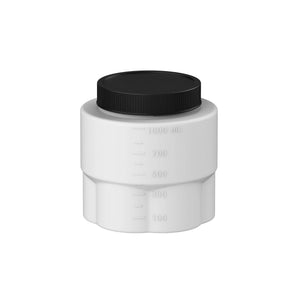
The Tilswall Hornet eliminates the issue by using its very own, specially designed special paint line. This paint line is designed to perform flawlessly straight from the bottle, with absolutely no mixing, thinning, or measurement needed. This is a truly plug-and-play experience. You simply connect the bottle into the Hornet and begin spraying right away. In spite of the sophisticated design, there's no compromising on the creativity of the line. It comes with a surprisingly wide and vibrant color palette, which allows users to quickly find the specific shades you require for everything from rusty sci-fi armors to vivid fantasy-themed miniatures.
Step 3: Distance, Execution, and Technique
Be sure to test the pattern on scrap paper prior to aiming your target. The sprayer is held approximately 15-20 cm (6 up to eight inches) away from the model. Instead of pulling on the trigger and pressing it while you move around in an uncontrolled manner, you should use gentle, smooth movements from side to side. Move your hand until you pull the trigger and let the trigger go prior to stopping your hand motion. Apply several ultra-thin coats, rather than trying to cover complete coverage with one large, heavy stroke.
Step 4: The 60-Second Maintenance Flush
Due to the fact that the Hornet is equipped with a smooth and high-efficiency fluid flow path and a fast cleanup process, cleaning can be done in a matter of minutes. After your painting session has completed, just remove the paint bottle. Then, connect the bottle with water or cleaning solutions and spray through the system to a waste bucket. The process will take about 60 seconds or until the mist is completely transparent. The tool is now in storage or ready for an entire color shift.
Frequently Asked Questions (FAQ)
Will I have to buy mixers or thinners to mix the paint?
No. The Tilswall Hornet comes with a specific range of pre-thinned plug-and-play paints that plug directly into the body of the sprayer. It is not necessary to determine ratios or mix the thinners by hand.
Does the Hornet apply fine-detailed details to miniaturized models of 28mm or 32mm?
Yes. Because of its 100,000 RPM motor as well as swappable 0.5 mm and 0.8 mm nozzles made of copper, it disperses paint perfectly enough to spread soft primers and smooth base coats on tiny figurines with no pooling.
For how long will the battery last on one charge?
A Hornet has dual rechargeable 2000mAh batteries that provide enough runtime to manage many cosplay components, entire terrain sets, and large quantities of 3D prints during the course of a single workday.
Can it be done to change colors during a project?
It's incredibly simple. It's as simple as swapping the paint bottle, then screwing in bottles of cleaner or water, and running the system for 60 seconds until the system is clear. Then, you attach the next color bottle.
The Final Verdict
The perfect, professional final product on your customized 3D prints, costumes, and miniatures for hobby projects does not require a master's level in the chemistry of paint or a studio cluttered with acoustic compressors and limiting air pipes.
Through reducing the industrial power to a portable hand-held form factor of 450g, a dedicated tool such as the Tilswall Hornet Cordless Paint Sprayer is a complete reset of expectations for makers working in the present. It removes the demanding steps to master and the stifling cleanup obstacles that were present in older technology and lets you have much less time trying to troubleshoot your tools and more time in making your designs come to life.


)